
BallEngine

Glass Tower:
Twice as much glass every bounce

One ball, one tower of identical glass plates, and a break quota that doubles on every single bounce until the last pass takes out everything that is left.
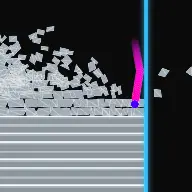
A frame from Glass Tower
Open the studio to run this mode live.

What Glass Tower does

One ball falls down a tower of identical glass plates, and each bounce punches through twice as many as the last before rebounding all the way back to the top.

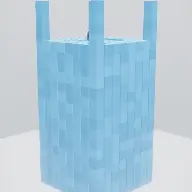
Glass Tower is a doubling mechanic dressed as destruction. A single ball falls inside a tall rectangle packed with identical full-width glass plates. On the first bounce it breaks a small number of them, then rebounds. On the next it breaks twice as many. Then twice as many again.

Every plate is the same. Nothing gets easier or harder and no plate is special. The only thing that changes is how many the ball is allowed to destroy before it stops, and because that quota doubles, the run escalates on a curve the viewer can feel long before they could count it.

The other half of the design is the rebound. However deep the ball has punched, it comes back up to the height it started from. So each arc is visibly longer than the one before, the descent takes longer, and the run reads as one ball hammering deeper and deeper into a tower that keeps getting taller beneath it.

How a run plays out

The exact sequence the engine runs in this mode, from the first frame to the moment the run resolves.
  1. 1.

    A ball falls between two walls

    The run opens with one ball inside a tall rectangle, bouncing off its two vertical sides as it descends. Side Walls and Random Launch decide how much lateral movement it has on the way down.

  2. 2.

    It punches through its quota

    Each glass shatters at the point the ball touches it, and the ball keeps going straight down through the stack rather than bouncing off each one. It stops when it has destroyed this bounce’s quota, then rebounds off the next intact plate.

  3. 3.

    The quota doubles every bounce

    The quota starts at a base count and is multiplied by the growth factor on each bounce, so the sequence runs two, four, eight, sixteen and onward. The plates never change; only how many break at once does.

  4. 4.

    Every rebound returns to the top

    The ball is sent back to its original spawn height rather than some multiple of the chunk it just ate. Each fall is therefore longer than the last, and the camera follows the ball down a stack that can run thousands of pixels tall.

Every control in Glass Tower

These are the settings this mode adds on top of the shared physics, visual, audio, and export controls. Names match the studio sidebar exactly.

Glass Stack

  • Glass Stack
  • Glass Color Mode
  • Palette
  • Bottom Color
  • Outline Color
  • Glass Glow

The stack is auto-sized so the final bounce consumes it exactly. Colour mode is what stops a thousand identical plates reading as a flat wall: a gradient down the tower gives the descent a visible sense of depth.

Ball and container

  • Ball Physics
  • Random Launch
  • Side Walls
  • Outer Rectangle
  • Show Border
  • Border Color
  • Border Glow

Random Launch varies the entry angle so a series of runs is not identical. The border is what defines the tower as an object rather than as the whole screen.

Breaking and effects

  • Glass Shatter
  • Shelf Break Effect
  • Completion Effect
  • Default Break Sound
  • Auto Reset & Loop

The shelf break effect fires per bounce and the completion effect fires once at the end. Keeping them different is what stops the last bounce feeling like just another bounce.

Counter and audio

  • Show Counter
  • Counts
  • Position
  • Prefix
  • Suffix
  • Font
  • Text Color
  • Override Global Audio
  • Wall Bounce
  • Glass Break
  • Finale (All Glass Broken)

The counter turns the doubling into a number. A viewer watching it go 8, 16, 32 understands the curve immediately, which is most of why this format holds attention.

Why Glass Tower videos hold attention

What keeps people watching this mechanic.

Doubling is understood without being explained

By the third bounce the pattern is obvious. Nobody needs a caption to know the next one will be bigger, and knowing it is what makes them wait for it.

Each arc is longer than the last

Because the rebound always returns to the top, the descent takes visibly more time on every pass. The run paces itself into longer and longer held breaths.

Destruction with a clean read

The ball punches a straight line through the stack rather than scattering it. The damage is legible as a single decisive action instead of as noise.

The stack has an exact bottom

The tower is sized so the last bounce consumes it precisely. The video ends on the frame the last plate breaks, which is a real ending rather than a fade.

Videos you can make in this mode

Each of these is a different configuration of the same mode, so one setup session produces a batch of related uploads.

Straight doubling run

Base count of two, growth factor of two, counter on. The clearest possible version of the mechanic and the best first video.

Gradient tower

A palette that shifts down the stack so the ball is visibly deeper on each pass. The cheapest way to make the depth readable.

Counter-led

A large counter with a prefix, positioned high in the frame. Turns the video into a number going up, which travels well as a thumbnail.

Slow and heavy

Lower ball speed with a strong shatter effect. Fewer, bigger moments rather than a fast cascade.

Looping tower

Auto Reset and Loop on, for a video that runs continuously on a feed that rewards watch time over completion.

Colour-coded finale

A distinct bottom colour so the last section is unmistakably the end. Viewers can see the finish approaching and stay for it.

Make your first Glass Tower video

The order that works. Following it out of sequence usually means retuning settings you already set.
  1. 1.

    Open the mode

    Launch the studio in Glass Tower. The stack is generated automatically from the bounce count, so there is nothing to build by hand.

  2. 2.

    Set the number of bounces

    This is the length of the video. Each additional bounce roughly doubles the plates broken and adds a longer descent, so add them one at a time.

  3. 3.

    Colour the stack

    Choose a palette with a visible change from top to bottom. Identical plates in one colour make a long descent look static.

  4. 4.

    Turn the counter on

    Position it clear of the ball’s path, add a prefix if the number needs context, and check it is readable at phone size.

  5. 5.

    Check the finale

    Play through to the end and confirm the completion effect and the finale sound land together on the last plate.

Settings that make the difference

  1. The bounce count is the runtime. Everything else changes how the run looks, but only this changes how long it is.
  2. Give the bottom of the tower its own colour. It tells the viewer the end is close without a caption or a timer.
  3. The counter is worth more than any particle effect here. The mechanic is arithmetic, and showing the arithmetic is the whole hook.
  4. Random Launch keeps a series from looking copy-pasted while leaving the doubling untouched.
  5. Keep the shelf break effect lighter than the completion effect, or the last bounce will not read as the finish.

What breaks a run

  1. Adding too many bounces. Doubling means the last bounce is longer than everything before it combined, and a run can outstay itself in one step.
  2. Using one flat colour for the whole stack. The descent then has no sense of depth and the longer falls feel like nothing is happening.
  3. Hiding the counter behind the ball path. It is the clearest signal in the mode and it needs to stay readable.
  4. Turning the border off. Without it the tower stops being an object and the run looks like it is happening in empty space.

Why every plate is identical

The obvious way to build an escalating destruction video is to make the obstacles tougher: thicker glass, more hits, a boss plate at the bottom. This mode does the opposite and keeps every plate exactly the same. The escalation lives entirely in the quota.

That choice keeps the read clean. When plates differ, a viewer has to work out whether the ball got stronger or the glass got weaker, and the answer is never visible from the frame. When they are identical, there is only one variable, and the fact that eight broke where four broke before is unmistakable.

It also keeps the pacing predictable. Doubling is a curve you can plan a video around: the bounce count sets the length, and you know before you shoot that the final bounce will account for about half the destruction in the run.
The rebound to the original height

A physically plausible rebound would send the ball up by some amount related to the chunk it just broke through. This mode deliberately sends it back to its original spawn height every time, and the effect is worth the licence.

It means each descent is longer than the last, which paces the video without any change in speed. Early bounces are quick and busy, late ones are a long fall through empty space where the tower used to be, then a burst of destruction at the bottom. The rhythm of the run emerges from the geometry.

It also keeps the camera work simple. The ball always starts a fall from the same place, so the follow camera has a stable frame of reference and the descent never jumps. Watching the same starting point produce a longer and longer drop is the clearest possible statement that the ball is getting deeper.

Glass Tower questions

Open Glass Tower

Every control on this page is already in the studio. Load the mode and start from a working run.