
The Viral Physics Video Blueprint: How Satisfying Simulations Get Millions of Views
A tactical masterclass on engineering retention and shares for physics videos, hook formulas, tension-release, sound design, seamless loops, captions, hashtags, and reading your analytics.
The Viral Blueprint for Satisfying Physics Videos
Scroll through TikTok, Reels, or YouTube Shorts for five minutes and you will hit at least one: a single ball trapped inside a spinning shape, bouncing faster and faster until it finally breaks free. A tiny marble racing down a track while a familiar song plays note by note on every collision. A swarm of balls doubling until they overflow. These clips rack up millions of views, and they do it without a face, a script, or a studio. They win on pure motion, sound, and timing.
Here is the part most people miss: these videos are not lucky. The satisfying feeling they produce is the result of choices you can reverse-engineer and reproduce on purpose. Motion that resolves. Sound that lands on the beat. A loop that never quite lets you leave. This is a working blueprint for engineering that effect, built specifically for physics and ball-simulation content and the creators making it with tools like BallEngine. Whether you are chasing your first thousand views or trying to make a channel repeatable, this covers the psychology, the hook formulas, the sound design, the loop, the captions, the posting strategy, and how to read your own analytics so every video teaches you something for the next one.
Key takeaways
- Physics videos are retention machines because motion creates an open loop the brain wants to see resolve, and the payoff arrives on a satisfying timeline.
- The first second decides everything: state a clear question or promise the viewer needs answered, then make them wait for it.
- Tension and release is the core engine. Escape and Ghost Escape modes are purpose-built for building pressure and delivering a clean payoff.
- Audio-visual sync is your unfair advantage. When bounces play an actual melody, the video stops being watchable and becomes rewatchable.
- A seamless loop multiplies watch time for free, because a viewer who cannot find the seam watches twice without deciding to.
- Mobile clarity, honest captions, consistent posting, and disciplined reading of your analytics turn one hit into a repeatable system.
The Psychology of the Scroll-Stop: Why Physics Is a Retention Machine
Short-form platforms are ranked, in broad and widely-observed terms, by how well a video holds attention: how long people watch, how often they finish, how many rewatch it, and how many share or save it. You cannot see the exact formula, and anyone who claims to is guessing. But you do not need the formula. You need to reliably produce the human behaviors those systems reward. Physics content is unusually good at producing them, and it helps to understand why.
Motion opens a loop the brain wants to close
The human visual system is wired to track motion and predict where it is going. A ball speeding up inside a shrinking boundary is an unresolved question rendered in pure movement: will it escape, and when? That unanswered question is an open loop, and open loops are uncomfortable in a way that keeps eyes on the screen. The viewer is not consciously deciding to keep watching. They are waiting for the loop to close. That is the same mechanism behind a cliffhanger, except it runs on physics instead of plot, so it needs no language and crosses every border and feed on earth.
Predictable rules, unpredictable outcome
Satisfaction lives in the gap between order and surprise. If a video is fully predictable, it is boring. If it is pure chaos, it is noise. Physics simulations sit in the sweet spot: the rules are obvious within a second (gravity pulls down, walls bounce, the ball is trapped) but the exact path is impossible to compute in your head. Your brain keeps trying to predict the next bounce and keeps being slightly wrong, and each small surprise is a tiny hit of interest that resets the attention clock.
Resolution feels good, and you control the timing
When the ball finally escapes, or the swarm finally fills the container, or the last brick shatters, the built-up tension resolves all at once. That release is the satisfying payload. The craft is in the timeline: too fast and there was never any tension to release; too slow and the viewer leaves before the reward. Most of the work in this guide is really about controlling that clock, and a studio with over a thousand physics parameters exists precisely so you can tune it frame by frame instead of hoping.
The core insight: you are not making a video of a ball. You are opening a question in the viewer's mind and controlling exactly how long they have to wait for the answer. Everything else is production.
The First Second: Engineering the Hook
You do not get a fair chance to make a first impression. On a fast-moving feed, the viewer decides within roughly a second whether to keep watching or flick away, and that first frame is competing against an infinite supply of other videos. A weak opening is the single most common reason a strong idea never gets seen. The fix is to treat the first second as its own discipline.
Lead with the question, not the setup
Amateur videos open with a slow build: an empty container, a ball drifting into place, nothing at stake yet. By the time anything interesting happens, the viewer is gone. Professional hooks open at or near the moment of tension. Start with the ball already moving, the boundary already tight, the stakes already legible. The viewer should understand the game and feel the pressure before they have finished the thought that would make them scroll.
Make a promise the viewer needs to see kept
A great hook is a promise plus a delay. The promise says what payoff is coming ("this ball will escape," "this will play the whole song," "these will fill the jar"). The delay makes them wait for it. A caption like "wait for the last bounce" is doing both jobs at once: it names the payoff and it tells the viewer the reward is at the end, which is a direct instruction to watch to completion. We will come back to captions, but understand that the hook is not only the visual, it is the visual and the first line of text working together.
Different modes create different kinds of hooks, and matching the hook type to the mode is how you stop guessing. Here is a working map from the promise you want to make to the BallEngine mode that delivers it best.
| Hook type | How it works | Best mode |
|---|---|---|
| Will it escape? | A ball is trapped in a shrinking or spinning boundary; the open question is whether and when it breaks free. | Escape |
| It is falling behind | A ball loses to the closing boundary but keeps getting one more chance, stacking near-misses before it survives. | Ghost Escape |
| This plays a whole song | Every bounce is a note; the viewer stays to hear a melody they recognize complete itself. | Rhythmic |
| Watch it fill up | A swarm grows or accumulates toward a container's brim; the payoff is the exact moment of overflow. | Merge 2048 / Accumulation |
| Total destruction | A ball chews through a wall of bricks; the promise is a fully cleared field. | Breaker |
| Who wins the race? | Multiple balls compete down a track or through pegs; the hook is a leaderboard with no clear leader. | Marble Run / Plinko |
| Tighter and tighter | A ball spirals inward as speed climbs; the tension is visible acceleration toward a limit. | Spiral |
Notice that every one of these is a question the viewer cannot answer without watching to the end. That is the whole point. If a stranger could guess your ending from the first frame, you do not have a hook, you have a thumbnail.
Tension-Release Engineering: The Escape Formula
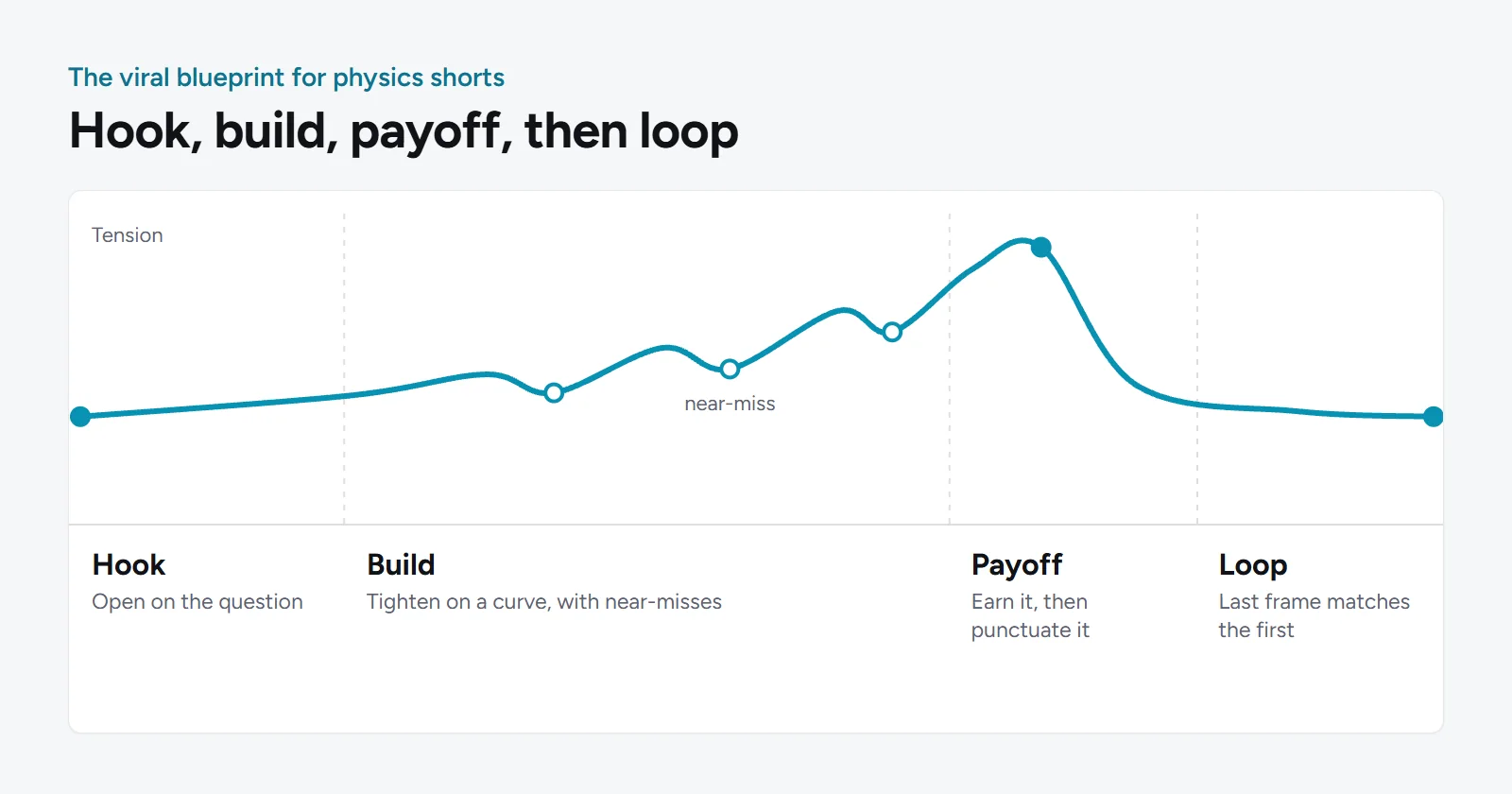
If you only master one structure, make it tension and release, and the cleanest place to build it is Escape mode. The shape is simple: a ball is confined, the confinement gets harder to survive over time, the danger of failure feels real, and then the ball breaks free. That arc maps directly onto how attention works: rising pressure holds the viewer, the payoff rewards them for staying, and a reward at the end is exactly what pushes completion rate up.
Build the pressure on a curve, not a line
Tension should accelerate. If the difficulty ramps at a flat, steady rate, the viewer adapts and the pressure stops registering. Instead, keep the early moments relatively calm to establish the rules, then tighten faster and faster toward the climax. A ball that bounces lazily for a moment and then suddenly seems trapped and frantic tells a story in motion. With granular control over gravity, speed, boundary size, and collision behavior, you can shape that curve deliberately rather than accepting whatever the default produces.
The near-miss is your best friend
The single most powerful beat in a tension video is the almost. The ball nearly escapes and gets knocked back. It nearly gets crushed and survives by a pixel. Each near-miss resets the open loop and buys you several more seconds of attention, because the viewer just got proof that the outcome is genuinely uncertain. This is the entire premise of Ghost Escape, where a ball that should have lost keeps earning one more chance. Stacking near-misses is how a fifteen-second idea legitimately holds attention for forty.
Earn the payoff, then punctuate it
The release only feels satisfying if the tension was real, so never shortcut the build to rush the ending. When the payoff lands, punctuate it: a burst of particles, a screen shake, a boundary shattering, a sound that hits harder than any bounce before it. The viewer should feel the difference between the tension and the release in their body, not just see it. That contrast is the satisfaction, and it is also the moment most likely to earn a rewatch as people go back to feel it again.
A payoff without tension is a shrug. Tension without a payoff is a betrayal. The satisfying video is the one that earns its ending and then makes you feel it.
The Audio-Visual Sync Advantage
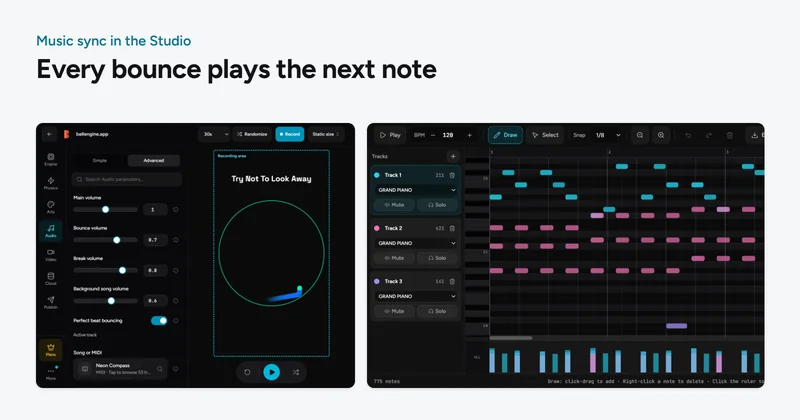
Here is where physics content gets a genuinely unfair edge, and where most creators leave the most value on the table. When the motion is synchronized to music, the video crosses from something you watch into something you feel, and feeling is what gets shared. This is the core reason BallEngine was built around music-synced simulation rather than treating audio as an afterthought.
Why sync hijacks attention
When a bounce lands exactly on a beat, two of your senses confirm the same event at the same instant, and the brain reads that agreement as a small reward. String enough of those together and you get a rhythm the viewer physically wants to follow to the end. This is the mechanism behind every satisfying music video ever made: motion and sound locked together so tightly that leaving early feels like walking out on a song. In Rhythmic mode, every collision plays a note, so the ball is not accompanied by music, it is performing the music.
Use a song people already know
Recognition is a powerful retention tool. When a viewer identifies a familiar melody in the first few notes, an even stronger open loop appears: they now need to hear the ball finish the song. Nobody abandons a recognizable tune two thirds of the way through. With MIDI import and musical scales, you can drive a simulation with a real melody instead of random tones, so the bounces resolve into something the ear expects. The full walkthrough for that lives in our guide on how to make a bouncing ball synced to music.
Design the sound, do not just add it
Sound is half of the satisfaction. The Audio Studio, spatial audio, and per-collision sound design mean you can make each bounce feel weighty, place sounds in the stereo field so a ball moving left to right is heard moving left to right, and make the climax audibly bigger than everything before it. Most viewers watch with sound on for exactly this kind of content, so a video that sounds designed will beat a video that merely has audio, every time.
If you are deciding where to invest first, invest in sync. A visually average clip with tight, musical audio will outperform a beautiful clip with generic sound, because sync is the rarest and most shareable quality in the entire category.
Designing a Seamless Loop
A loop is the closest thing to free watch time in short-form. When a video ends exactly where it began, the platform's auto-replay carries the viewer into a second viewing before they consciously decide to leave, and a second viewing is watch time you did not have to earn twice. Rewatches are among the clearest signals that a video is working, and a good loop manufactures them on purpose.
Match the first and last frame
The mechanical goal is simple: the final frame should be visually indistinguishable from the first. Same ball position, same boundary state, same energy. When the loop restarts, the viewer's eye finds no seam, so the clip reads as one continuous motion rather than a video that stopped and started over. Even a viewer who consciously notices the repeat often watches the loop point a second time just to confirm they saw it, which is exactly the behavior you want.
Two loop strategies that work
- The true cycle: the simulation returns to its starting state naturally, so the motion is genuinely continuous. Rhythmic patterns and orbiting or spiral setups lend themselves to this, because periodic motion wants to repeat.
- The reset-as-payoff: the video ends on a satisfying climax (the escape, the overflow, the final shatter) that visually resembles the calm opening, so the release doubles as the loop point. The eye reads the ending as a beginning and rides straight back in.
Do not fake a loop with a hard cut
A jarring jump from a chaotic final frame back to a still opening breaks the spell and reads as amateur, and viewers feel the discontinuity even if they cannot name it. If a clean loop is not achievable for a given idea, do not force it. Instead, lean the whole video toward a strong, decisive payoff so the ending is satisfying on its own terms. A great ending beats a broken loop, but a great ending that also loops is the ideal, and it is worth an extra pass to get there.
Visual Clarity for Mobile
Your video will be watched on a phone, in a vertical frame, often at arm's length, sometimes in bright sunlight, frequently for less than a second before the keep-or-scroll decision. Every visual choice has to survive that environment. Clarity decides retention here, because a viewer who cannot instantly read what is happening scrolls before the idea gets a chance.
Contrast is non-negotiable
The ball must pop off the background instantly. High contrast between the subject, the boundary, and the background is what makes the action legible at a glance and at thumbnail size. Dark backgrounds with a bright, saturated ball are a reliable default because they maximize separation and read well on both bright and dim screens. If you have to squint to find the ball, so will everyone else, and squinting is a scroll.
Size the action to the frame
Fill the vertical 9:16 frame with the action. A simulation floating tiny in the center with dead space around it wastes the exact real estate that decides attention. The boundary and the ball should be large enough that the motion is unmissable on a small screen. Export in true vertical up to 4K and 60fps so the motion stays crisp and smooth even after the platform re-compresses it, because compression punishes soft, low-contrast, low-framerate footage hardest.
- Keep any critical action out of the extreme top and bottom, where the platform's own interface (username, caption, buttons) covers the frame.
- Prefer bold, saturated colors over subtle gradients; subtlety is lost to small screens and aggressive compression.
- Favor smooth high-framerate motion; satisfaction depends on fluidity, and stutter reads as low quality instantly.
- Test your clip at actual phone size before publishing, not on a desktop monitor where everything looks clearer than it will in the feed.
Captions, Text Overlays, and the Wait-For-It Pattern
Text on screen is not decoration, it is a second hook running in parallel with the visual, and it is often the deciding factor in whether someone stays. The right overlay tells the viewer what to want and when the reward arrives, converting passive watchers into people who are actively waiting for something specific.
The wait-for-it pattern
The most reliable retention caption in the category is some version of "wait for it." It works because it does two things at once: it promises a payoff is coming, and it tells the viewer the payoff is at the end. That is a direct request to watch to completion, and completion is exactly the behavior that helps a video travel. Specific beats vague, so "wait for the last note" or "wait for it to escape" outperforms a generic "wait for it," because it names the reward and sharpens the open loop.
Set the stakes in one line
A single line of on-screen text can install the entire premise before the visual has to. "This plays the whole song with only bounces," "the ball speeds up every time it hits a wall," "it doubles until the jar overflows." Now the viewer knows the game and the goal in the first second, and a viewer who understands the stakes is a viewer with a reason to stay. Keep it to one short, legible line, place it where the platform's interface will not cover it, and make sure it is readable at a glance against your background.
Text as a mid-video re-hook
Attention decays across even a short clip, so use a well-timed text cue to re-hook viewers who are drifting: "almost," "one bounce left," "here it comes." A word that appears right before the climax pulls a wandering eye back to the screen exactly when the payoff is about to justify the wait. Used sparingly, these mid-video cues are one of the cheapest retention gains available, and they cost nothing but a moment of planning.
Your visual makes the promise. Your caption names it and puts a clock on it. Together they turn a viewer into someone who is waiting for something specific, and waiting is watching.
Hashtags and Metadata: Principles, Not Guarantees
Hashtags and metadata help a platform understand and categorize your video, which can help it reach the right audience. Their effect is small, and no tag will rescue a video that does not hold attention. Treat them as a modest, disciplined layer on top of a genuinely good clip, never as a substitute for one.
How to think about tags
- Describe the content honestly so the platform can match it to people who actually want it; misleading tags attract viewers who scroll instantly, which teaches the system the wrong thing about your video.
- Mix broad category tags with a few specific ones, so you signal both the general lane (satisfying, physics, animation) and the exact niche (ball simulation, marble run, music sync).
- Keep the set focused; a wall of loosely related tags dilutes the signal rather than strengthening it.
- Reuse the tags that correlate with your own best-performing videos, and let your real results, not generic lists, guide the set over time.
Metadata beyond hashtags
On YouTube Shorts especially, the title and description carry real weight for discovery and searchability, so write a title that states the hook in plain language a human would search for. Across every platform, the first line of your caption is prime attention real estate, so put your strongest hook line there rather than burying it after the tags. When you publish and schedule through BallEngine to as many as eight platforms with Autopilot, keep this in mind: the same clip can carry platform-appropriate metadata rather than one generic caption copied everywhere, and tuning per platform is a small effort with a real payoff.
The honest hierarchy: the video does ninety percent of the work, the hook and caption do most of the rest, and hashtags are a helpful nudge at the margin. Get that order backward and no amount of tagging will save you.
Posting Cadence and Timing
Consistency beats intensity. One thoughtful video posted every day for a month will teach you more, and reach more people, than thirty videos dumped in a single week and then silence. Short-form rewards creators who show up regularly, because a steady cadence gives you more chances to be seen and more data to learn from, and momentum compounds only if you keep feeding it.
Volume is how you learn
Especially early on, you do not yet know which of your ideas will connect, and no amount of theorizing substitutes for shipping. Every video is a test. Posting consistently is how you run enough tests to find the patterns that work for your specific audience. This is exactly why faceless, template-friendly content is such a strong model: once you have a repeatable production system, you can post daily without burning out. Our guide to building a faceless physics simulation channel goes deep on that engine.
Timing and scheduling
Post when your audience is most active so your video gets early engagement while it is fresh, and lean on your own analytics to find those windows rather than trusting a generic best-time chart that knows nothing about your followers. The practical unlock is scheduling: batch a week of content in one session, queue it, and let it publish automatically at consistent times across platforms. Autopilot and multi-platform scheduling exist precisely so cadence does not depend on you being awake and online at the perfect moment, which is the difference between a hobby and a system.
Key takeaways
- Pick a cadence you can sustain (daily is powerful; several times a week is plenty) and hold it long enough to gather real data.
- Treat every post as an experiment, not a verdict; one flop tells you almost nothing, ten posts tell you a pattern.
- Schedule and batch so consistency survives busy days and does not depend on manual posting.
- Let your own analytics, not generic advice, decide your posting windows and your content mix.
Reading Your Analytics and Iterating
The creators who improve fastest are the ones who read their numbers like a diagnosis instead of a scoreboard. Views are the outcome; the underlying metrics tell you why, and why is what you can act on. You do not need advanced analytics, you need to look at a few signals honestly and let them redirect your next video.
The metrics that actually guide you
- Average watch time and completion rate: the clearest read on whether your pacing and payoff are landing. Low completion usually means the middle sags or the ending disappoints.
- Retention curve (where people drop): a cliff in the first second is a hook problem; a slow bleed through the middle is a pacing or tension problem; a drop right before the end means your payoff arrives too late or lands too soft.
- Rewatches and loop behavior: high rewatches signal a satisfying payoff or a clean loop, which tells you to make more like that one.
- Shares and saves: the strongest signals of real resonance, because they mean a human chose to spend social capital or come back later; study what those specific videos did differently.
- Follower growth per video: which clips actually convert a viewer into a subscriber, versus which just get a passive glance.
Turn the read into a change
The point of looking is to change one thing on purpose. If viewers drop in the first second, your hook is the problem, not your idea, so rebuild the opening. If they bleed away in the middle, tighten the tension curve or add a mid-video re-hook. If they leave right before the payoff, move the climax earlier or make it hit harder. Change one variable at a time so you can actually tell what moved the number, then run it back.
The iteration loop
- Ship a video built around one clear hook and one clear payoff.
- Read the retention curve and the share and save numbers, not just the view count.
- Form one specific hypothesis about what helped or hurt ("the hook was too slow," "the loop earned the rewatches").
- Change exactly one variable in the next video to test that hypothesis.
- Compare the new numbers against the old, keep what worked, and discard what did not.
- Repeat, so every post compounds into a sharper instinct instead of a fresh guess.
Do this for a month and you will stop guessing. You will have a personal, evidence-based playbook for what your audience rewards, which is worth more than any generic advice, including this article. New to reading a studio's output and export settings? The getting started creator studio guide walks through the production side end to end.
10 Video Ideas to Start Today
Blueprints are useless without reps, so here are ten concrete concepts you can build now, each mapped to a mode and a hook. Pick one, ship it, read the numbers, and run the loop above.
- A ball trapped in a slowly shrinking circle in Escape mode, with the caption "will it escape in time?" Build the pressure on a curve and punctuate the breakout.
- A recognizable song played entirely by bounces in Rhythmic mode using MIDI import, captioned "guess the song before it finishes."
- A ball that keeps almost losing to a closing boundary in Ghost Escape, stacking near-misses, captioned "it should not have survived this."
- A Merge 2048 run where numbered balls combine toward a target, captioned "wait for the 2048."
- A Breaker clip where one ball clears an entire wall of bricks, captioned "total destruction," ending on the empty field.
- A multi-ball Marble Run race down a long track, captioned "which color wins?" with a visible leaderboard.
- A Plinko drop where many balls fall through pegs into bins, synced so each peg hit plays a note.
- A Spiral clip where a ball winds inward and accelerates toward a limit, captioned "tighter and tighter."
- An Accumulation build where escapes spawn more balls until a container overflows, captioned "wait for the overflow."
- A seamless-loop Rhythmic pattern designed so the first and last frame match exactly, so the platform's replay does the work for you.
Every one of these is free to start building in the browser. Explore the full range in the satisfying video generator, and if you want to see how the modes compare, our roundup of the best ball simulation software for 2026 breaks down where each one shines.
Frequently Asked Questions
Why do physics videos go viral?
How long should the video be?
What makes a good hook?
How often should I post?
Do hashtags matter?
Why did my video flop?
Do I need to show my face or talk?
What is the single most important element to get right?
How important is sound?
How do I make my video loop seamlessly?
Can I really do all of this for free?
How do I turn one hit into a repeatable channel?
Start Building Your First Viral Physics Video
The satisfying physics videos filling your feed are not accidents, and now they are not a mystery either. They open a question in the first second, build tension on a curve, deliver a payoff that is worth the wait, sync the motion to sound, and loop so cleanly you watch twice without deciding to. Every one of those is a choice you can make on purpose, and the fastest way to internalize it is to build one and read what the numbers tell you. Open the satisfying video generator, pick a mode and a hook from the ten ideas above, and ship your first clip today. When you are ready to make it a habit, create your free account and start turning the blueprint into a channel. If you have questions before you dive in, the FAQ covers the essentials.
Modes in this article
All modes
Tutorials for this topic
All tutorialsOptimising Clips for TikTok, Reels and YouTube Shorts
Framing, length, the opening seconds and the Studio settings that decide whether a vertical clip holds attention.
Physics Settings Deep Dive
Gravity, bounciness, speed, growth and arena resizing: what each physics setting does to a run, with the ranges you will find on the controls.
Related articles
View all articles
How to Build a Faceless YouTube & TikTok Channel With Physics Simulations (2026 Money Playbook)
The complete operator playbook for building and monetizing a faceless physics-simulation channel, niche selection, a production system, a 90-day growth plan, and every realistic revenue stream.
How to Make a Bouncing Ball Video Synced to Music (Complete 2026 Guide)
Everything you need to make a bouncing ball that plays a song, how music-synced physics works, a full step-by-step BallEngine workflow, MIDI and scale tips, and how to publish.