
BallEngine

Slime 3D:
A network nobody planned

Hundreds of thousands of agents that only sense the trail in front of them, building a vein network that has to reach every node before it starves.
Play the preview

In development0 creators want this next

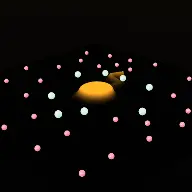
A frame from Slime 3D
Open the studio to run this mode live.

Slime 3D is being built right now

The engine, the physics and the look are done enough to watch. What is not finished is everything around them: the settings, the presets and the export path. So we shipped it as a preview instead of sitting on it.

The order is decided by these votes rather than by us, and the most-voted modes go first. If this is the one you want, say so.

What you can do now
Open it in the studio and watch a full run, with sound, exactly as it stands today.
What is held back
Settings, randomize and export. The preview runs on our defaults so every viewer judges the same version.
When it ships
The most-voted unfinished mode is the one we take next.

What Slime 3D does

Hundreds of thousands of agents following one local rule, building a pulsing vein network that has to reach every food node before it starves.

Slime mould does something that looks like planning and is not. Each agent deposits a trail, senses the trail ahead of it to the left, in front and to the right, and turns toward whichever is strongest. That is the entire rule, and out of it comes the branching vein network that famously reproduces transport maps.

Here that runs on the GPU at hundreds of thousands of agents. Each one is a position and a heading in a texture, the trail field is blurred and decayed every step, and four passes per frame do the whole simulation. Nothing coordinates the agents and nothing plans a route.

A raw slime field is beautiful ambient wallpaper with nothing to watch for. What turns it into a video is the objective: food nodes scattered across the field that the network has to reach, a counter for how many are connected, and a starvation finale if the growth stalls before it gets them all.

How a run plays out

The exact sequence the engine runs in this mode, from the first frame to the moment the run resolves.
  1. 1.

    Agents sense and turn

    Each agent samples the trail field ahead-left, ahead and ahead-right, and steers toward the strongest. It then deposits into the field itself, reinforcing whatever path it took.

  2. 2.

    The field decays

    The trail field is blurred and decayed every step, so paths that stop being used fade. Only routes that keep getting traffic survive, which is what prunes the network.

  3. 3.

    Nodes have to be reached

    Food nodes are scattered across the field. Connecting one changes its state and advances the counter, giving the growth a stated objective.

  4. 4.

    Starvation ends it

    If the network cannot reach the remaining nodes, the run ends in the starvation finale rather than growing indefinitely, so failure is a real outcome.

Every control in Slime 3D

These are the settings this mode adds on top of the shared physics, visual, audio, and export controls. Names match the studio sidebar exactly.

The objective

  • The Objective
  • Show Counter
  • Counter Word
  • Starvation Finale

This is the layer that makes it a video rather than a screensaver. The counter states what the network is trying to do and how far along it is.

Growth and trail

  • Growth
  • The Trail

Deposit strength and decay rate together decide whether the network is a dense mat or a sparse set of highways.

Agents

  • Agents
  • Detail

Agent count and field detail set how fine the veins are. Hundreds of thousands of agents is what makes the structure look continuous.

Look and beat

  • Look
  • Faint Trail
  • Bright Vein
  • Node (unreached)
  • Node (connected)
  • Beat Response
  • Pulse On Beat
  • Own Sounds
  • Connect Sound
  • Finale Sound

Unreached and connected nodes must be clearly different colours, because the difference between them is the entire progress readout.

Why Slime 3D videos hold attention

What keeps people watching this mechanic.

It looks like intelligence

A network that appears to be solving a routing problem is compelling on its own, and the fact that no agent knows anything is a genuinely surprising thing to learn.

The counter gives it stakes

Nodes connected out of nodes total turns an ambient growth into a task with a pass or fail outcome.

Failure is possible

The starvation finale means the network genuinely might not make it, which is what makes the last few nodes tense.

Pruning is visible

Unused paths fade while used ones brighten, so the network visibly refines itself rather than just spreading.

Videos you can make in this mode

Each of these is a different configuration of the same mode, so one setup session produces a batch of related uploads.

Connect them all

Food nodes scattered widely with the counter on. The version with the clearest objective.

Starvation run

Nodes placed far enough apart that reaching all of them is genuinely in doubt.

Dense mat

High deposit and low decay for a thick continuous network rather than distinct veins.

Sparse highways

Low deposit and high decay so only heavily used routes survive, producing a clean map.

Beat pulse

Pulse On Beat so the network throbs with the track while it grows.

Map recreation

Nodes placed at the positions of real cities, which is the experiment that made this organism famous.

Make your first Slime 3D video

The order that works. Following it out of sequence usually means retuning settings you already set.
  1. 1.

    Place the nodes

    Scatter the food nodes. Their spacing is what decides whether the run is comfortable or genuinely at risk.

  2. 2.

    Turn on the counter

    State how many are connected out of how many. This is what makes the run a task.

  3. 3.

    Balance deposit and decay

    Higher decay prunes harder and produces cleaner veins. Higher deposit spreads faster and fills more.

  4. 4.

    Colour the nodes

    Unreached and connected nodes need clearly different colours, because that difference is the progress bar.

  5. 5.

    Set the finale

    Decide whether the run can fail. A possible starvation makes the last nodes far more tense.

Settings that make the difference

  1. The objective layer is what separates this from a screensaver. Do not turn the counter off.
  2. Decay is the pruning control. If the network looks like an undifferentiated mat, raise it.
  3. Node spacing is the difficulty. Widely spaced nodes make the starvation finale a real possibility.
  4. Distinct node colours are essential, since connected versus unreached is the entire progress readout.
  5. Recreating a real map with the node positions is the experiment this organism is famous for and it makes an excellent video.

What breaks a run

  1. Running without the objective, which leaves a beautiful field with nothing to watch for.
  2. Very low decay, so nothing is ever pruned and the network becomes a solid mat with no visible structure.
  3. Nodes so close together that connecting them all is trivial and the counter never feels at risk.
  4. Similar colours for reached and unreached nodes, which hides the only progress signal in the mode.

One rule, no coordination

Each agent does exactly three things: it samples the trail field at three points ahead of it, it turns toward the strongest, and it deposits into the field. It has no memory of where it has been, no knowledge of the nodes, and no communication with any other agent.

The network that emerges is entirely a product of the field. A path that gets used is reinforced, which makes it more attractive, which makes it get used more. A path that stops being used decays away. The result is a structure that reproduces the shape of efficient transport networks without anything in the system representing efficiency.

This is worth stating on screen if you are making a video about it, because the surprise is the content. What people find remarkable is not that the pattern is pretty, it is that a system with no planner produced something that looks planned.
The objective is what makes it a video

A raw physarum field is ambient. It grows, it prunes, it looks extraordinary, and there is no moment in it that is more important than any other. A viewer can leave at any point without missing anything, and they do.

Adding food nodes changes the question from what does this look like to will it get there. The counter states the score, connecting a node is an event with a sound, and the remaining unreached nodes are a visible list of what is still to do.

The starvation finale completes it by making failure possible. Without it, waiting is always eventually rewarded and the tension is fake. With it, a network that has spent its growth in the wrong direction genuinely does not make it, and the last two nodes are worth watching.

Slime 3D questions

Open Slime 3D

Every control on this page is already in the studio. Load the mode and start from a working run.