BallEngine

Drum Sort 3D:
Chaos sorting itself out

Thousands of mixed-colour balls tumbling in a slowly rotating drum, separating into clean bands down the barrel and then doing it all again.
Play the preview

In development0 creators want this next

A frame from Drum Sort 3D
Open the studio to run this mode live.

Drum Sort 3D is being built right now

The engine, the physics and the look are done enough to watch. What is not finished is everything around them: the settings, the presets and the export path. So we shipped it as a preview instead of sitting on it.

The order is decided by these votes rather than by us, and the most-voted modes go first. If this is the one you want, say so.

What you can do now
Open it in the studio and watch a full run, with sound, exactly as it stands today.
What is held back
Settings, randomize and export. The preview runs on our defaults so every viewer judges the same version.
When it ships
The most-voted unfinished mode is the one we take next.

What Drum Sort 3D does

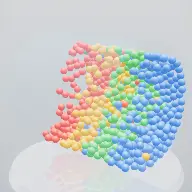
Mixed-colour balls tumbling in a slowly rotating drum that separate themselves into clean colour bands, over and over.

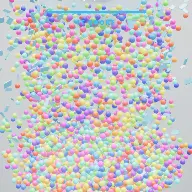
Drum Sort 3D is chaos resolving into order, on a loop. Thousands of mixed-colour balls tumble inside a slowly rotating cylinder, and over the course of a run they separate themselves into clean bands of colour down the barrel. Then it mixes and does it again.

Real rotating drums do segregate material, which is a genuine and well-studied effect. They also do it slowly and unreliably, which is fine for a physics paper and useless for a thirty-second video. So the drum here supplies the motion and a weak per-colour affinity supplies the order.

Each colour owns a band slot along the drum’s axis, and a single pass per step nudges balls toward their slot. The tumbling is what the viewer sees; the affinity is what guarantees a finished run reads as clean discs down the barrel in palette order rather than as an almost-sorted mess.

How a run plays out

The exact sequence the engine runs in this mode, from the first frame to the moment the run resolves.
  1. 1.

    The drum rotates slowly

    A cylinder turns on its axis, tumbling the balls inside it. The rotation supplies all of the visible motion and all of the mixing.

  2. 2.

    Each colour owns a slot

    Every colour in the palette is assigned a band position along the drum axis, so a finished run reads as ordered discs rather than as arbitrary clumps.

  3. 3.

    A weak affinity does the sorting

    One pass per step nudges each ball toward its colour’s slot. It is weak enough that the tumbling still dominates, and strong enough that the run reliably finishes.

  4. 4.

    Order forms and the loop repeats

    The bands sharpen over the run until the barrel is clean, and then the cycle begins again, which is what makes the mode work as endless background content.

Every control in Drum Sort 3D

These are the settings this mode adds on top of the shared physics, visual, audio, and export controls. Names match the studio sidebar exactly.

The drum

  • The Drum
  • Orientation
  • Show Drum
  • Drum Tint
  • Tumble

Orientation decides whether the bands form across the frame or into it. Across is more legible on a vertical canvas.

The sort

  • The Sort

How strongly the affinity pulls. Weak takes longer and looks more natural; strong finishes quickly and looks more obviously guided.

Colour

  • Colour
  • Palette (comma-separated hex)

The palette is both the look and the number of bands. Fewer colours give wide obvious bands; more give a finer stripe pattern.

Audio

  • Override Audio

The tumbling supplies a continuous texture, so this mode usually sits under a track rather than driving one.

Why Drum Sort 3D videos hold attention

What keeps people watching this mechanic.

Order emerging is inherently satisfying

Watching disorder resolve into structure is one of the few things that holds attention with no premise and no stakes at all.

Progress is visible continuously

The bands sharpen gradually, so at any moment the run is measurably further along than it was.

It loops without an ending

The cycle repeats forever, which suits feeds that reward total watch time rather than completion.

It survives half attention

There is nothing to follow and nothing to miss, so it works as ambient content in a way most formats do not.

Videos you can make in this mode

Each of these is a different configuration of the same mode, so one setup session produces a batch of related uploads.

Classic sort

A handful of strongly separated colours in a horizontal drum. The clearest read of the effect.

Fine stripes

A large palette so the finished barrel is a fine banded gradient rather than a few blocks.

Slow sort

A weak affinity so the sorting takes most of the run. Feels more like real segregation and less like guidance.

Vertical drum

Orientation changed so the bands stack rather than run across. A different composition from identical physics.

Brand palette

Channel colours as the palette, which turns the finished barrel into a piece of branding.

Glass drum

Drum tint set so the cylinder reads as glass, which gives the tumbling material depth.

Make your first Drum Sort 3D video

The order that works. Following it out of sequence usually means retuning settings you already set.
  1. 1.

    Set the palette

    Choose the colours. This decides both the look and how many bands the finished run has.

  2. 2.

    Choose the orientation

    Horizontal reads better on a vertical canvas because the bands run across the frame.

  3. 3.

    Tune the affinity

    Weak enough that the tumbling dominates, strong enough that the run finishes inside your runtime.

  4. 4.

    Set the tumble

    Rotation speed decides how energetic the mixing looks. Slower reads as heavier material.

  5. 5.

    Watch a full cycle

    Confirm the bands actually finish clean before the loop restarts, and adjust the affinity if they do not.

Settings that make the difference

  1. Strongly separated colours are essential. Similar hues never look sorted even when they are.
  2. A weaker affinity looks more natural but needs a longer run. Match it to the length you actually want.
  3. Horizontal orientation is usually right for a vertical canvas, since the bands then run across the widest axis.
  4. This mode is a good candidate for a longer export, because the loop never needs an ending.
  5. A tinted glass drum gives the tumbling depth and stops the barrel reading as a flat shape.

What breaks a run

  1. A palette of similar shades, which makes the finished sort invisible.
  2. A very strong affinity, which sorts the material almost instantly and removes the entire arc.
  3. Too many colours in a small drum, where the bands are too thin to read.
  4. Hiding the drum entirely, which leaves the balls apparently sorting themselves in mid-air.

Real segregation, helped

Granular material in a rotating drum genuinely does segregate by size and density. It is a real effect with a substantial literature behind it, and if you run a physical drum for long enough you will see bands form.

The problem is timescale and reliability. Real segregation takes minutes to hours and often produces a partial, messy result. Building a thirty-second video on it would mean either an extremely fast forward or a run that frequently fails to finish.

So the drum provides the motion and a weak per-colour affinity provides the ordering. Every colour owns a slot along the axis, and one linear pass per step nudges balls toward theirs. The affinity is deliberately weak: it has to lose to the tumbling moment to moment, and only win over the length of the run.
Why the bands are in palette order

Assigning each colour a fixed slot along the axis means the finished state is not merely sorted, it is sorted into a specific arrangement. The barrel ends as discs in palette order, every time.

That predictability is what makes it usable as branded content. A channel with a fixed palette gets the same final image on every run, so the finished barrel becomes recognisable rather than incidental.

It also makes the run legible while it is happening. A viewer who can see where each colour is heading can watch the bands assembling rather than waiting to find out what the answer is, which turns a slow process into something with visible direction.

Drum Sort 3D questions

Open Drum Sort 3D

Every control on this page is already in the studio. Load the mode and start from a working run.