BallEngine

Eulers Disk 3D:
Which one screams last?

Fifty spinning coins, each accelerating into a dead stop, arranged so the field thins in the order the formation asks for and the last one lands on the drop.
Play the preview

In development0 creators want this next

A frame from Eulers Disk 3D
Open the studio to run this mode live.

Eulers Disk 3D is being built right now

The engine, the physics and the look are done enough to watch. What is not finished is everything around them: the settings, the presets and the export path. So we shipped it as a preview instead of sitting on it.

The order is decided by these votes rather than by us, and the most-voted modes go first. If this is the one you want, say so.

What you can do now
Open it in the studio and watch a full run, with sound, exactly as it stands today.
What is held back
Settings, randomize and export. The preview runs on our defaults so every viewer judges the same version.
When it ships
The most-voted unfinished mode is the one we take next.

What Eulers Disk 3D does

Around fifty spinning coins rising to a scream and then stopping dead, one at a time, in the order the formation asks for.

A spinning coin settling on a table does something strange near the end. The rattle speeds up, the pitch climbs, and then it stops abruptly rather than fading. That acceleration into silence is a real physical effect, and Eulers Disk 3D turns it into a format by doing it about fifty times at once.

The disks have different masses, so they settle at different times. They are arranged in a formation, and each formation parks its stops on different beats: the middle first, or the rim first, or a whole ring at a time, or a spiral chasing its own tail. The field thins out one scream at a time.

Which leaves the question the run is built on: which one screams last? The disks stop in the order the formation asks for, and the final one lands on the drop. The physics is closed-form settling, so the timing is exact rather than approximate.

How a run plays out

The exact sequence the engine runs in this mode, from the first frame to the moment the run resolves.
  1. 1.

    A field of disks is laid out

    Around fifty coins of different masses are arranged in one of roughly two hundred formations, each of which places its stopping order differently across the field.

  2. 2.

    Each disk settles by law

    The settling is closed-form rather than integrated, so the moment each disk reaches its singularity is known exactly and can be placed on a specific beat.

  3. 3.

    The riser is the sound of it

    The rattle accelerating into the stop is the mode’s voice. It can be snapped to a scale so the risers form a chord rather than a noise.

  4. 4.

    The stops land on the song

    Each disk’s stop is parked on a beat, so the field thins in time with the music and the last one resolves on the drop.

Every control in Eulers Disk 3D

These are the settings this mode adds on top of the shared physics, visual, audio, and export controls. Names match the studio sidebar exactly.

The run

  • The Run
  • Loop
  • Formation
  • Settle Order
  • Coin Sizes
  • Table Shape
  • Field Size

Formation and settle order together are the choreography. Middle-first and rim-first read as completely different videos with identical physics.

The physics

  • Settling Law
  • Decay Law

These govern how quickly the rattle accelerates into the stop, which is the difference between a gentle settle and a scream.

The riser

  • The Riser
  • Riser Voice
  • Snap to Scale
  • Where the Stops Land
  • Snap Stops to the Song

Snap to Scale is what stops fifty simultaneous risers becoming noise. On a scale they stack into a chord instead.

Look and hook

  • What the Disks Are
  • Lightest Disk
  • Heaviest Disk
  • Show HUD
  • Hook Text
  • Name the Mass
  • HUD Accent

Colouring by mass makes the stopping order predictable to the viewer, which turns watching into anticipating.

Why Eulers Disk 3D videos hold attention

What keeps people watching this mechanic.

The riser is a physical hook

An accelerating rattle that stops dead is a sound people respond to before they have identified it. It fires dozens of times in a run.

The field visibly thins

Progress is legible without a counter. Fewer disks are spinning than a moment ago, and the run is clearly heading toward one.

The last disk is a question

Which one screams last is answerable only at the end, and the formation makes it guessable without making it obvious.

Stops land musically

Because each stop is parked on a beat, the thinning is rhythmic rather than random and the ending resolves with the track.

Videos you can make in this mode

Each of these is a different configuration of the same mode, so one setup session produces a batch of related uploads.

Middle out

A formation whose singularities stop from the centre outward, so the field opens up as it thins.

Rim first

The inverse, closing in toward a final disk at the centre. The most obviously climactic ordering.

Ring by ring

Whole rings stopping together, which gives the run visible chapters instead of a continuous thin-out.

Spiral chase

A spiral order that appears to chase its own tail around the table. The most hypnotic of the formations.

Chord riser

Risers snapped to a scale so the overlapping screams form a chord that resolves on the final stop.

Mass-coloured field

Lightest and heaviest disks strongly differentiated so the viewer can predict the order and be right.

Make your first Eulers Disk 3D video

The order that works. Following it out of sequence usually means retuning settings you already set.
  1. 1.

    Pick the formation

    This is the choreography of the entire run. Play two or three before committing.

  2. 2.

    Set the field size

    More disks means a longer, denser run. Around fifty is the default for a reason.

  3. 3.

    Snap the risers

    Put the riser voice on a scale so overlapping stops harmonise instead of clashing.

  4. 4.

    Park the stops on the song

    Snap the stops to the track so the thinning is rhythmic and the last disk lands on the drop.

  5. 5.

    Colour by mass

    Give lightest and heaviest disks distinct colours so the order is readable as the field thins.

Settings that make the difference

  1. Snap to Scale is the difference between a chord and a mess. With fifty risers overlapping, it is not optional.
  2. Rim-first formations produce the most climactic endings, because the last disk is in the middle where everyone is already looking.
  3. Colour by mass so viewers can predict the order. Being right is more satisfying than being surprised here.
  4. Set the last stop on the drop. The whole run is a build toward one moment and it should land with the music.
  5. The settling is closed-form, so an offline render reproduces the timing exactly.

What breaks a run

  1. Unsnapped risers across a large field, which turns the signature sound into noise.
  2. A field so large the individual stops stop registering as events.
  3. Random settle order, which throws away the choreography the formations exist to provide.
  4. A last stop that does not coincide with anything in the track, leaving the payoff unsupported.

The scream is the whole format

A settling disk does something counterintuitive: as it loses energy the rattle gets faster, not slower, and then it stops abruptly. The contact point races around the rim quicker and quicker until the motion terminates in what is effectively a finite-time singularity.

That is a rare shape for a sound. Nearly everything in the physical world fades, and a thing that accelerates into silence instead is arresting even to someone who has never seen a coin do it. It is also perfectly suited to a short-form video, because it is a self-contained build and payoff lasting about a second.

So the mode is built around repeating it. One disk is a curiosity, fifty disks with staggered masses is a format, and arranging when each one arrives at its singularity is where the authoring happens.
Formations are choreography

Because the settling law is closed-form, the exact moment a given disk stops is known in advance. That makes it possible to park each disk’s singularity on a chosen beat rather than letting the physics land wherever it lands.

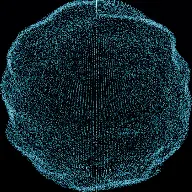
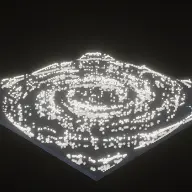
A formation is a plan for those parkings, and there are around two hundred of them. Middle-first opens the field outward. Rim-first closes it inward on a final disk at the centre. Ring-by-ring gives the run visible chapters. A spiral appears to chase itself around the table.

None of these change the physics; every disk settles by the same law. What changes is the order the stops arrive in, and that ordering is the difference between a field of coins running down and a run that reads as though someone directed it.

Eulers Disk 3D questions

Open Eulers Disk 3D

Every control on this page is already in the studio. Load the mode and start from a working run.