BallEngine

Lava Survival:
The floor is coming up

A shaft of staggered platforms, named marbles with nowhere to go, and a hazard that climbs one step on every bar of the song.
Play the preview

In development0 creators want this next

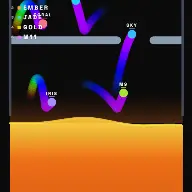
A frame from Lava Survival
Open the studio to run this mode live.

Lava Survival is being built right now

The engine, the physics and the look are done enough to watch. What is not finished is everything around them: the settings, the presets and the export path. So we shipped it as a preview instead of sitting on it.

The order is decided by these votes rather than by us, and the most-voted modes go first. If this is the one you want, say so.

What you can do now
Open it in the studio and watch a full run, with sound, exactly as it stands today.
What is held back
Settings, randomize and export. The preview runs on our defaults so every viewer judges the same version.
When it ships
The most-voted unfinished mode is the one we take next.

What Lava Survival does

Named marbles are trapped in a shaft of staggered platforms while a hazard climbs a step every bar. Touch it and you are out.

Lava Survival puts marbles in a tall vertical shaft full of staggered platforms and starts a hazard rising from the floor. Lava, water or acid, depending on how you dress it. Touching it removes you. The last marble alive wins a podium, and then it starts again.

This is not a race, and the difference matters. In a race the tension is ambition and the loser simply arrives late. Here nobody has anywhere to go. The safe part of the arena is shrinking, the survivor count only ever falls, and a viewer who has picked a favourite spends the whole clip watching a threat move toward it. That is a stickier shape.

The hazard rises one step per bar rather than continuously. Between steps it is completely still. Every bar is therefore a held breath followed by a lurch, and the arena audibly loses another slice of itself on the beat.

How a run plays out

The exact sequence the engine runs in this mode, from the first frame to the moment the run resolves.
  1. 1.

    Marbles are trapped, not racing

    Named marbles bounce among staggered platforms in a tall shaft. There is no finish line and nowhere to get to, only higher ground to stay on.

  2. 2.

    The hazard climbs a step per bar

    The rising surface moves in discrete steps timed to the music’s bars rather than creeping continuously. Between steps it is dead still, which is what creates the held-breath rhythm.

  3. 3.

    Contact eliminates

    A marble that touches the hazard is out. There is no health and no second chance, so every step of the rise can take somebody.

  4. 4.

    Last one alive takes the podium

    When one marble remains, a podium banner shows the result and the shaft resets. The survivor ticker counts down toward that moment throughout.

Every control in Lava Survival

These are the settings this mode adds on top of the shared physics, visual, audio, and export controls. Names match the studio sidebar exactly.

Marbles and shaft

  • Marbles
  • Shaft
  • Platform Layout
  • Wall Color
  • Platform Color

The platform layout decides where safety exists. A sparse layout produces early eliminations, a dense one keeps the field alive into the upper shaft.

The hazard

  • Climb
  • Rising Hazard
  • Follow The Song
  • Hazard Color
  • Surface Glow

Follow The Song is the signature setting. With it on the hazard steps once per bar; with it off the rise is continuous and the tension flattens out.

On-screen

  • Show Survivor Ticker
  • Show Names
  • Camera

The ticker is the countdown. Names are what let a viewer follow one marble through a crowded shaft.

Audio

  • Source
  • Melody
  • Jumps Sing
  • Platform Bounces Sing
  • Hazard Rise (per bar)
  • Elimination
  • Last Survivor
  • Jump
  • Platform Bounce
  • Override Global Audio

Giving the hazard rise its own per-bar sound is what makes the threat audible. The viewer hears it approach even when looking at a marble near the top.

Why Lava Survival videos hold attention

What keeps people watching this mechanic.

The threat is visible and approaching

Loss aversion is a stronger driver than ambition. A viewer watching something they picked get closer to danger is far more engaged than one watching it try to arrive first.

Every bar is a held breath

The stepwise rise creates a repeating beat of stillness and lurch. The video has a pulse built into its central threat.

The safe zone shrinks

The playable area only ever gets smaller, so the density of near-misses rises automatically as the run goes on.

The count only goes down

The survivor ticker is a one-way number. There is no recovery and no comeback, which makes each elimination final and worth reacting to.

Videos you can make in this mode

Each of these is a different configuration of the same mode, so one setup session produces a batch of related uploads.

Classic lava rise

Named marbles, lava hazard, ticker on. The plainest and most reliable version.

Acid shaft

The same run dressed as acid with a strong surface glow. Same mechanic, different channel identity.

Sparse platforms

Fewer platforms so safety is scarce from the start. Eliminations begin early and the field thins fast.

Tall shaft endurance

A long shaft with dense platforms, for a run where the field survives deep into the climb.

Named audience run

Marbles named from comments. The identity does the work and the format produces its own sequel.

Two-marble finale

A small field so the whole video is effectively the showdown. Very short and very tense.

Make your first Lava Survival video

The order that works. Following it out of sequence usually means retuning settings you already set.
  1. 1.

    Name the marbles

    Give each one a name and a distinct colour so viewers can follow one through the shaft.

  2. 2.

    Choose the platform layout

    This decides how much safety exists and therefore how fast the field thins. Play one run before committing.

  3. 3.

    Sync the hazard

    Turn on Follow The Song so the rise steps once per bar. This is the setting that gives the mode its rhythm.

  4. 4.

    Voice the rise

    Give the per-bar rise its own sound so the threat is audible without being on screen.

  5. 5.

    Check the finish

    Watch a full run to the podium. If the last two are eliminated in the same step, add platforms near the top.

Settings that make the difference

  1. Follow The Song is the mode. A continuous rise removes the held breath and turns a tense format into a slow one.
  2. Sparse platforms near the top make for a better finish, because the last survivors have somewhere to nearly fall from.
  3. The survivor ticker matters more than names in a large field, since it is the only signal that reads at a glance.
  4. A strong surface glow on the hazard keeps it readable against a busy shaft.
  5. Do not run too many marbles. The mode is about watching one, and a crowd makes that impossible.

What breaks a run

  1. Turning off the song sync, which flattens the central rhythm of the whole format.
  2. Too many platforms, so nobody is eliminated for the first twenty seconds and the run has no early events.
  3. A hazard colour close to the platform colour, which makes the threat hard to locate in a glance.
  4. Treating it like a race and adding a finish line. There is nowhere to go, and that is the point.

Loss aversion beats ambition

A race asks who will get there first. It is a fine question, but it is answered by whoever is ahead, and a viewer who can see the leader can predict the ending. The emotional register is hope, and hope is easy to abandon halfway.

A rising hazard asks who will still be here. There is no way to get ahead, only to not be taken, and the viewer’s attention is fixed on a threat rather than on a goal. People are considerably more attentive to something bad approaching a thing they have chosen than to that thing making progress.

This is why the mode shares none of the race machinery. There is no finish line, no leaderboard and no standings, because all of them would invite the viewer to read the run as a competition with a predictable winner instead of as a survival situation with an unpredictable one.

Why the rise is stepwise

A continuously rising hazard is technically simpler and dramatically flat. It is always moving, so no individual moment is more dangerous than the one before, and the viewer’s alertness settles into the constant.

Stepping once per bar breaks that. Between steps the surface is completely still and the marbles are safe, and then it lurches and takes whoever was in the wrong place. The run becomes a sequence of discrete threats rather than one continuous one, and discrete threats can each be anticipated.

It also makes the arena audible. With a sound on the per-bar rise, a viewer watching a marble near the top still hears the danger moving, and the audio and the bar structure of the music agree with each other rather than running independently.

Lava Survival questions

Open Lava Survival

Every control on this page is already in the studio. Load the mode and start from a working run.